Context
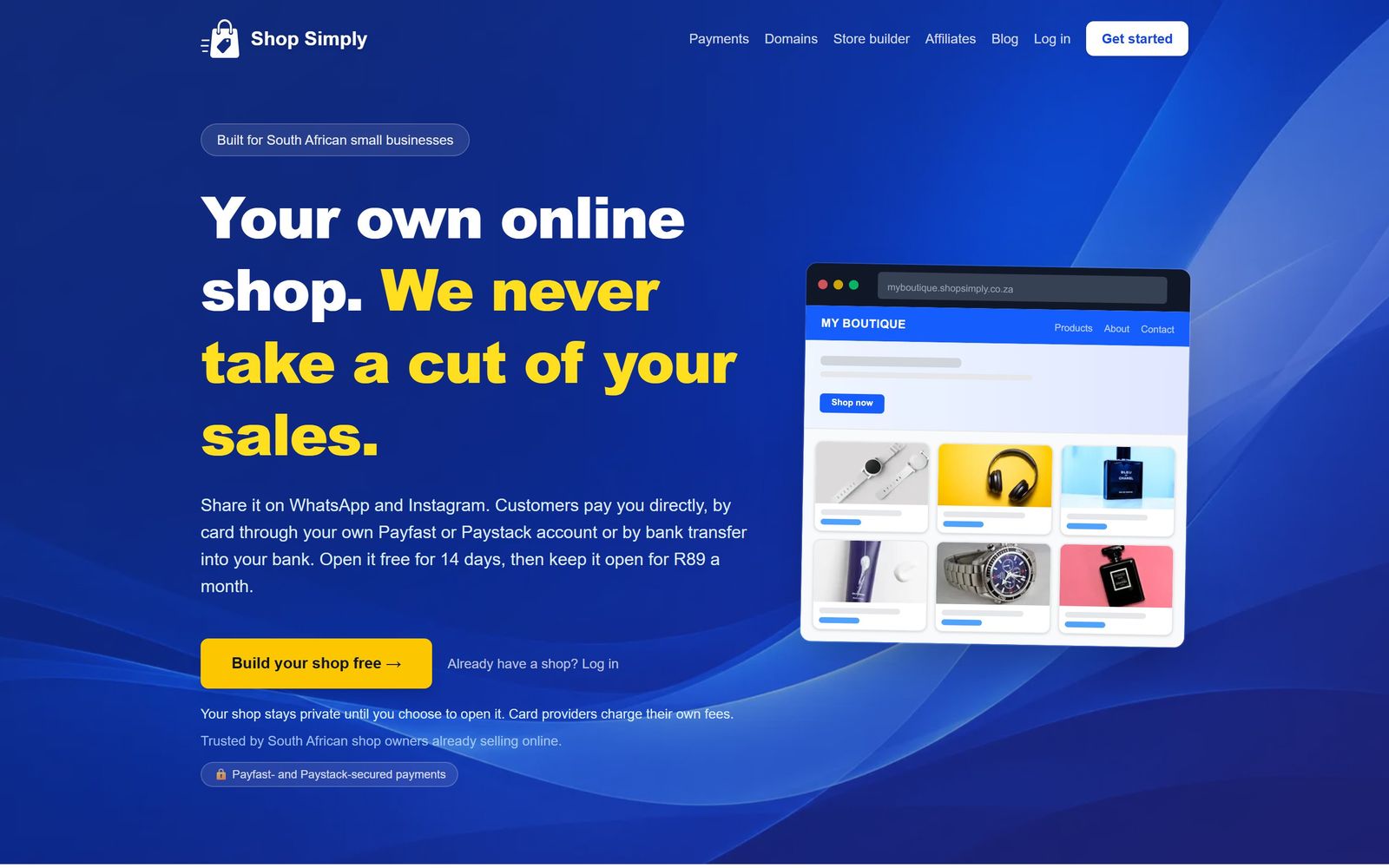
Shop Simply is Tech Mage’s own product: online shops for South African small sellers. It is live at shopsimply.co.za. Tech Mage designed it, built it and runs it every day, so this case study covers both the build and what it takes to keep a live platform healthy.
The problem
Small sellers in South Africa often show their stock on WhatsApp and Instagram. What they need next is a shop of their own: a catalogue with photos, a checkout and one link to share. The platform has to let a seller set that up alone, on a phone, and get paid directly, by card or by bank transfer, without sending their customers somewhere else.
Constraints
- Sellers are not technical. Setting up a shop, adding stock and pointing a domain at it all have to work without help from a developer.
- The phone is the main device. Sellers photograph their stock on a phone and upload it from there.
- Payments go to the seller. Card payments run through the seller’s own Payfast or Paystack account, and bank transfers go straight into the seller’s bank account.
- One operator. The platform is run by Tech Mage, so routine work has to be automated and every alarm has to mean something.
What we did
Shop Simply is a multi-tenant web application built with Next.js on Node.js and hosted on Microsoft Azure.
- A shop per seller. Each seller gets a shop at their own address on shopsimply.co.za, and can connect a domain of their own. The platform checks the domain’s DNS records and issues the security certificate for it.
- Private until opened. A new shop stays private while the seller builds it, and opens to shoppers when the seller chooses.
- Direct payments. Sellers connect their own payment provider account or bank details, so customers pay the seller and Shop Simply never holds the money.
- Scheduled work and monitoring. Scheduled jobs handle the routine work, such as lapsed trials and unpaid bank-transfer orders, and health checks watch payments and domains.
- AI agent operations, run in-house. Day-to-day engineering, product and support work is done by AI agents working to written specifications. Andre makes the calls that should stay human: architecture, security, money and anything that cannot be undone.
The result
Shop Simply is live, and Tech Mage runs it day to day. Running it is also how Tech Mage proves its own way of working on a live platform, not only on client projects.
What we learned
- Ask every alarm what silences it, and what turns it back on. An alarm written to catch something that never worked can go quiet forever after one success.
- One reading of a value that changes is a sample, not a fact. Two readings an hour apart turn “probably wrong sometimes” into a measured interval that can be acted on.
- Where a feature’s link lives says what it was built for. A feature reachable only from one screen is used only for that screen’s purpose, so put it where the work happens.
- Use the field that means the thing. A shop’s visibility and its subscription status agree almost always, and disagree exactly when a customer is looking.